Imagine you live in a U.S. city and want to move savings into crypto to protect against account freezes or to support a small business that prefers privacy-respecting payments. You care about both convenience — a phone you can use at a café — and the assurance that your transaction history, IP address, and keys won’t leak to third parties. That concrete tradeoff — mobility versus confidentiality — is exactly where modern privacy wallets live and where many users make costly mistakes.
This commentary unpacks how a high-quality mobile privacy wallet actually protects you, what it cannot do, and how feature choices change the balance between usability and plausible privacy. I draw on the architecture and capabilities common to advanced privacy-first wallets (examples include Monero support, optional Tor routing, hardware signers, and device-level encryption) and synthesize the practical implications for U.S. users looking to store or move Monero (XMR), Bitcoin (BTC), Haven (XHV), and other assets.
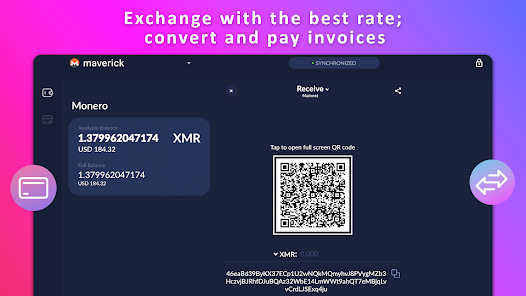
Mechanisms: How a Privacy Mobile Wallet Works (and Why Each Layer Matters)
Think of a privacy wallet as a stack of defenses, each addressing a different leakage channel. The most relevant layers are key custody, transaction construction, network routing, and device security. Here’s how they interact in practice and why they matter.
First, custody. Non-custodial design means the private keys never leave your device; they are not stored by the developer or on a server. That’s foundational: if someone else holds the keys, your privacy and control vanish. A well-built wallet keeps the private view key (important for Monero) and signing keys strictly local, and many modern wallets explicitly ensure the Monero private view key never leaves the phone. This alone doesn’t guarantee anonymity, but it prevents remote custody risks and reduces the attack surface to the device and the user’s operational security.
Second, transaction mechanics. For Bitcoin, privacy hinges on how inputs and outputs are chosen. Tools such as PayJoin (now evolving to PayJoin v2), silent payments, UTXO-level coin control, and transaction batching are practical techniques to reduce linkability. PayJoin breaks the clear ‘single-sender’ model by having recipient contribute inputs, which confounds heuristic clustering used by chain analysis firms. UTXO coin control lets users decide which outputs to spend, preventing accidental consolidation that paints a clearer ownership trail. For Litecoin, optional MWEB (MimbleWimble Extension Blocks) adds an extra privacy layer by aggregating and obfuscating amounts and ownership — optional, because it changes interoperability.
Third, network privacy. Even perfect on-chain privacy can be pierced by network-level leaks: your IP, timing, and node connections can correlate you with addresses. A wallet that supports Tor-only mode, I2P, or custom node connections gives users the means to hide where transactions originate. This is especially important in the U.S., where ISPs and service providers can be compelled to hand over metadata. Use of Tor or I2P is not a magic bullet — misconfiguration, DNS leaks, or connecting to hostile nodes can still expose metadata — but these modes raise the bar substantially.
Fourth, device-level security. Wallet data encrypted using device hardware (Secure Enclave on iOS or TPM on Android) and protected by a PIN/biometrics reduces the risk of extraction if your phone is seized or stolen. Hardware wallet integration (Ledger, or air-gapped solutions like Cupcake) adds a further layer: signing happens off the phone or in an isolated environment, so even a compromised phone cannot produce valid signatures without physical approval. This combination — local keys, hardware-backed encryption, and optional air-gapped signing — is what turns a mobile wallet from a convenience toy into a defensible privacy tool.
Concrete Trade-offs: Where Privacy Wallets Shine and Where They Break
These mechanisms are powerful but not omnipotent. Understand the trade-offs so you can match a wallet’s design to your risk model.
Trade-off 1 — Convenience vs. Opsec discipline. Built-in swaps and instant exchange features (using decentralized routing like NEAR Intents) make it easy to move between BTC, XMR, ETH, and Haven (XHV) without using a centralized exchange. That convenience reduces on-chain exposure to regulated platforms. But swapping inside a wallet can create new linkages if you reuse addresses or rely on custodial liquidity providers. Good practice: use new subaddresses for receipts, and understand whether a swap path reveals amounts or parties to intermediaries.
Trade-off 2 — Privacy-by-default vs. user control. Some wallets enforce privacy — for example, forcing Zcash to be shielded when sending out — which prevents accidental leaks. Enforced behaviors are protective for non-expert users, but they can reduce flexibility for advanced users who need transparent transactions for compatibility. Similarly, optional features like Litecoin’s MWEB require activation; users must weigh compatibility with exchanges and counterparties against improved confidentiality.
Trade-off 3 — Network anonymity vs. speed/reliability. Tor and I2P routing hide IP metadata but can slow sync times or create usability issues with push notifications. In the U.S., the privacy benefits are significant because surveillance and legal processes can yield logs; yet for time-sensitive business transactions, the delay might be impractical. A pragmatic compromise is to use privacy routes for balance consolidation and high-value transfers and less-private connections for low-stakes monitoring.
Trade-off 4 — Non-telemetry vs. support. A strict zero-data collection policy improves privacy posture but reduces the telemetry developers can use to diagnose bugs. In practice, that means support interactions may require users to volunteer logs or steps, and some edge-case bugs may persist longer. This is a conscious trade: you accept a higher maintenance burden in exchange for a reduced exposure of your device metadata.
Common Misconceptions and a Sharper Mental Model
Two misconceptions recur among privacy seekers. First: “Using Monero automatically makes everything invisible.” Not true. Monero provides stronger default privacy than Bitcoin, but operational errors — reusing addresses, leaking view keys, or running a wallet in a clear-IP environment — degrade privacy. The sharper model: privacy is an interaction between protocol properties (ring signatures, stealth addresses, confidential transactions) and operational hygiene (node choice, network routing, key management).
Second: “A mobile wallet is inherently insecure.” That’s an over-simplification. Mobile devices have attack surfaces, but modern security primitives — hardware-backed encryption, PIN/biometrics, and hardware-wallet integrations — can make a properly used mobile setup defensive enough for many threats, including casual theft and remote compromise. The right question is threat-specific: against a targeted nation-state with device malware and physical seizure, only air-gapped, compartmentalized workflows and stringent opsec offer high assurance. For everyday privacy from data brokers, advertisers, and casual snooping, a non-custodial, hardware-backed mobile wallet combined with Tor/I2P is often sufficient.
Decision Framework: How to Choose and Configure a Wallet
Use this short heuristic to evaluate choices with clarity:
1) Identify your threat model. Are you protecting from account freezes and data brokerage, or from well-resourced forensic investigators? The former requires strong privacy hygiene and a non-custodial wallet; the latter requires air-gapped signing and careful operational policies.
2) Map assets to features. If you intend to hold Monero and Litecoin with MWEB, prioritize a wallet that supports native XMR background sync, subaddresses, and optional MWEB. If you use Bitcoin professionally, ensure PayJoin v2, UTXO coin control, and batching are supported.
3) Prioritize network anonymity. If ISP-level metadata matters, use wallets that offer Tor-only or I2P modes and allow custom nodes. Test them: confirm that the wallet can sync and broadcast through Tor reliably before moving significant funds.
4) Add hardware signing for large amounts. For life-changing sums, integrate a Ledger or an air-gapped signer like Cupcake. Even with a secure phone, hardware signing reduces the remote attack surface dramatically.
5) Operational checklist: use fresh subaddresses for receipts, avoid address reuse, keep the private view key local for Monero, back up seed phrases securely, and remember that Zcash migrations from some other wallets (Zashi) require manual transfers because of incompatible change-address handling.
What to Watch Next: Signals and Near-Term Implications
Three signals matter for U.S. users over the next 12–24 months. First, regulatory attention to privacy-preserving features may increase; watch how exchanges and custody providers adapt to MWEB and shielded ZEC flows. Second, the usability gap for high-assurance workflows (easy air-gapped signing, seamless Tor integration) is narrowing; expect improved UIs but remain cautious about hidden trade-offs. Third, cross-chain privacy routing (decentralized systems like NEAR Intents used for swaps) will grow in importance: they reduce reliance on custodial intermediaries but create complex privacy dynamics that users must understand before relying on them for anonymity.
Each of these trends is conditional: regulatory moves could restrict some features, or improved tooling could make higher-assurance privacy accessible to many more users. Monitor developer transparency (open-source code, no-telemetry policies), hardware integration options, and whether default behaviors favor privacy-by-default or user choice.
FAQ
Q: Is a mobile privacy wallet sufficient for holding Monero securely in the U.S.?
A: For most individuals protecting against data collection and casual targeting, a mobile non-custodial wallet with device encryption, Monero-specific controls (background sync, subaddresses), and Tor/I2P routing provides robust protection. For state-level adversaries or scenarios involving device seizure, add hardware-backed signing and compartmentalized workflows; understand that no single tool makes you invulnerable.
Q: How does swapping inside a wallet affect privacy?
A: Built-in swaps using decentralized routing (e.g., NEAR Intents) reduce exposure to centralized exchanges but can create linkage if intermediate market makers record trade metadata or if you reuse addresses. The privacy outcome depends on implementation: some decentralized routes reveal less counterparty data than a centralized exchange, but they are not automatically anonymous. Use fresh addresses and review swap path disclosures where available.
Q: Should I use Tor for every transaction?
A: Tor materially improves network anonymity and is recommended when privacy concerns are significant. However, Tor can slow sync times and may interfere with real-time notifications. A pragmatic approach: use Tor for meaningful transfers and balance checks where anonymity matters, and a faster connection for low-risk monitoring.
Q: What about Haven (XHV)? Is it supported and private?
A: Wallets that support Haven let you hold and transfer XHV alongside Monero and other assets. The privacy properties depend on Haven’s protocol design and the wallet’s implementation. Treat it like any other asset: confirm background sync behavior, keys remaining local, and whether the wallet exposes any additional metadata during swaps or transfers.
Final practical note: if you are specifically looking for a wallet with strong Monero integration, hardware wallet options, Tor/I2P support, and a no-telemetry stance, research wallets that combine these properties and test them with small amounts first. For an entry point focused squarely on Monero usability and privacy on mobile, consider exploring a dedicated monero wallet that exposes the features discussed above and verify the implementation choices against your threat model.